A homeowner sends your roofing company a message about a leak. Your team replies, offers an inspection and sends an estimate. Then the conversation goes quiet.
It is tempting to assume the lead was poor or another roofer offered a lower price. Sometimes that is true. But the problem can also be an unclear next step, a missed follow-up or a proposal that leaves the homeowner unsure what they are buying.
Learning how to win roofing leads means improving the experience between the first inquiry and the customer's decision. You need relevant opportunities, a reliable response process, clear estimates and enough evidence to help people trust your company.
This guide focuses on that conversion process. If you need to attract more inquiries first, start with our roofing lead generation guide. If inquiries are already arriving but too few become jobs, work through the steps below.
1. Define the roofing leads you can actually serve
A roof replacement inquiry, a small repair request and a commercial maintenance opportunity should not automatically follow the same sales process.
Before spending more on marketing, define your ideal jobs. Consider your service area, roof types, project scope, available crew capacity and the kind of work your team is equipped to complete.
Then give your office a short intake checklist:
- Where is the property?
- What problem has the customer noticed?
- Is the request for a repair, replacement, inspection or something else?
- Is the person authorized to arrange the work?
- What timing are they hoping for?
- What is their preferred way to communicate?
Ask these questions conversationally. A homeowner dealing with water entering the house does not want to complete a lengthy sales questionnaire before learning whether you can help.
Avoid diagnosing the roof from a short message. Record the reported issue and explain what an inspection would establish. Do not ask homeowners to climb onto the roof to provide photographs.
A relevant lead is someone your business can genuinely help. Record unsuitable inquiries separately so they do not distort your sales conversion figures.
2. Match your marketing promise to the actual service
Roofing leads become harder to win when the advertisement promises something the business cannot deliver.
An ad for emergency roof repair should lead to a page that clearly explains your actual availability and response process. A roof replacement campaign should explain the assessment, materials and estimating process rather than send every visitor to a generic homepage.
Review the complete path:
Search or advertisement → service page → inquiry → first conversation → inspection → estimate.
Each step should continue the same conversation. If the page advertises a free inspection, disclose any conditions before the customer books. If a visit carries a fee, say so clearly. Do not imply round-the-clock attendance unless your team provides it.
Your roofing Google Ads strategy and roofing SEO pages should attract work you want, in areas you serve. Better matching can be more useful than simply increasing traffic.
For practical campaign examples, see our guide to roofing ads.
3. Give every inquiry an owner and a response plan
A lead can be lost even when several people receive the notification. If everyone assumes someone else will respond, nobody does.
Assign a primary owner and a backup. Decide who monitors forms, phone calls, chat messages and advertising-platform inboxes during business hours. Define what happens outside those hours.
Google's Local Services lead-management guidance describes tools for receiving and managing inquiries. If you use that channel, include its inbox in your response process rather than assuming every inquiry will appear wherever your team normally works.
Set a realistic response target based on your staffing. Measure the time to an actual response attempt separately from an automated acknowledgment. An instant confirmation is useful, but it does not establish that a qualified person has reviewed the problem.
An acknowledgment could say:
Thanks for contacting [Company]. We received your roofing inquiry. Our team will contact you during [actual business hours] to confirm the property details and discuss the next step. This message does not confirm an appointment.
Use accurate placeholders before sending. Match the message to the channel and applicable consent requirements.
Our contractor lead handoff checklist can help you define ownership and prevent inquiries from disappearing between marketing and the office.
4. Make the first conversation helpful
The purpose of the first call is to understand the situation and agree on a useful next step. You do not need to force a sale before the homeowner understands the process.
A simple opening might be:
Hi [Name], this is [Representative] from [Company]. You contacted us about [reported issue]. Is now a suitable time to ask a few questions and explain how our inspection process works?
Confirm the details you already have instead of making the person repeat the entire inquiry. Ask what they have observed and what matters most to them: resolving a leak, understanding the roof's condition, planning a replacement or comparing options.
Explain what your team can establish during the assessment and what remains uncertain. Avoid promising an insurance outcome or a replacement recommendation before the appropriate assessment. Questions about policy coverage belong with the customer's insurer or another appropriately qualified professional.
If the job is outside your scope, explain that promptly. A clear, honest answer is more useful than collecting an appointment your team cannot service.
5. Turn inspection booking into a clear agreement
“Someone will come out” leaves too much room for confusion.
Confirm the date, appointment window, property address, contact person and any access requirements. Explain whether someone needs to be present and whether the appointment is a confirmed booking or a request awaiting approval.
Where relevant, explain the inspection fee and what it includes. Give customers a simple way to reschedule.
Send a confirmation through the agreed channel and connect it to the actual calendar. An automated reminder should not keep sending the original time after an appointment changes.
Some roofing jobs need qualification before scheduling. Others may suit online booking. Our comparison of quote request forms and online booking explains how to choose the right approach.
Track completed inspections separately from scheduled inspections. A calendar full of tentative appointments does not tell you how many assessments your team actually performed.
6. Show evidence that answers the homeowner's concerns
A homeowner may hesitate because they do not know how to judge the condition of the roof or compare contractors. Relevant evidence makes that decision easier.
Use authorized project photographs, accurate descriptions of completed work and genuine customer feedback. Explain what an example demonstrates: the type of roof, the problem addressed and the work performed.
During an assessment, document observations clearly and distinguish what you can verify from what needs further investigation. If photographs are appropriate, explain what they show without exaggerating the damage.
Make credentials and insurance information available as applicable. The FTC's post-disaster contractor guidance advises consumers to investigate contractors, compare estimates and obtain written details. A transparent sales process should make those checks straightforward.
Avoid presenting an illustrative image as a completed customer project. Likewise, a positive review about communication is not evidence of a particular financial result.
Our project gallery guide explains how to give portfolio images useful context.
7. Write an estimate the customer can understand
A price without an explanation makes it difficult for a homeowner to compare proposals fairly.
A useful roofing estimate should explain the proposed scope, materials, relevant exclusions, expected timing and payment arrangements. Clarify how unexpected conditions would be assessed and how additional work would require approval. Describe applicable warranty terms accurately rather than relying on broad promises.
Present alternatives only when they are appropriate for the property and supported by the assessment. Explain the differences without making the least expensive option deliberately confusing.
After sending the estimate, offer to walk through it:
I have sent the proposal for [property/project]. It explains the recommended work, materials and exclusions. Would a short call help you compare the options or clarify anything before making a decision?
Use written agreements appropriate to your jurisdiction and project. This article is about communication and workflow, not a substitute for contract or licensing advice.
8. Follow up with a reason, not repeated pressure
A follow-up should help the homeowner move forward. Sending “Are you ready?” every day rarely adds useful information.
Agree on a follow-up date where possible. For example, if the homeowner wants a week to review several estimates, note that preference and schedule a task for the responsible person.
An adaptable follow-up sequence might include:
- Confirm that the estimate arrived through the agreed channel.
- Offer to answer questions about scope, materials or exclusions.
- Follow up on the date the customer requested.
- Close the loop politely if the customer is no longer interested.
This is a planning example, not a mandatory messaging schedule. Adjust it for the customer's preferences, the urgency of the work and applicable communication rules. Stop automated sales messages when someone declines, opts out or becomes a customer.
A useful message might be:
Hi [Name], following up as agreed about your roofing estimate. Is there anything you would like clarified about the proposed work? If your plans have changed, let us know so we can update our records.
See our roofing CRM and estimate follow-up guide for a more detailed workflow.
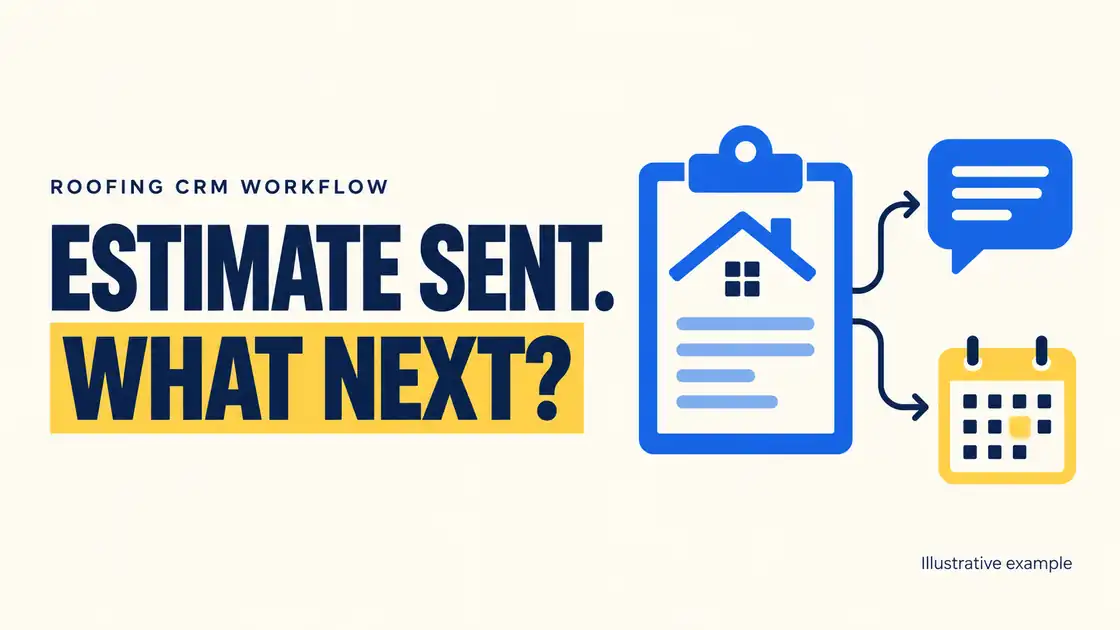
9. Use your CRM to protect the next action
A roofing CRM should tell your team what to do next, not simply store a list of names.
Useful stages may include new inquiry, contact attempted, conversation completed, inspection scheduled, inspection completed, estimate sent, decision pending, won and closed without a sale.
Define the evidence needed to move between stages. An email being sent does not mean a conversation happened. A customer asking a question does not mean the job is accepted.
For every active opportunity, record an owner, a next action and a due date. Keep the lead source and service requested attached to the record. A returning customer with a new roofing project may need a separate opportunity rather than another duplicate contact.
CRM setup and GoHighLevel automation can support these processes, but software cannot resolve unclear responsibilities on its own.
Begin with task assignments and reminders. Add more complex automation only after you have tested how the workflow handles replies, cancellations, rescheduling and duplicate inquiries.
10. Find the stage where roofing opportunities are lost
Measure the journey using consistent definitions and a reasonable observation period. Roofing projects can take time to close, so do not compare this week's new leads directly with this week's sales and assume they are the same group.
| Measure | Calculation | What to investigate |
|---|
| Contact rate | Leads reached ÷ valid leads | Contact details, coverage and response attempts |
| Booking rate | Inspections booked ÷ qualified conversations | Fit, availability and clarity of the next step |
| Inspection completion rate | Inspections completed ÷ inspections booked | Confirmations, cancellations and access issues |
| Estimate win rate | Accepted estimates ÷ estimates issued to the same lead group | Scope, pricing, evidence and decision follow-up |
| Advertising cost per acquired job | Attributed ad spend ÷ jobs won from that campaign | Channel economics and attribution quality |
For example, suppose a fictional roofing company receives 40 valid inquiries and reaches 30 people. Its contact rate is 75%. If 20 of those conversations are qualified and 12 book inspections, the booking rate among qualified conversations is 60%.
These figures are illustrative, not industry benchmarks. Their purpose is to show where to investigate. A weak contact rate calls for a different response than a weak estimate win rate.
Track reasons for losses where customers share them. Use “unknown” when you do not know; do not automatically blame price. Our contractor marketing dashboard guide explains how to keep these measures organized.
Frequently asked questions
How do I win roofing leads without lowering my price?
Make the scope and value of the work clear. Explain materials, exclusions, process and applicable warranty terms, then provide relevant evidence and answer questions. Some homeowners will still choose a lower-priced option; the aim is an informed decision, not winning every inquiry.
Are exclusive roofing leads better than shared leads?
The label alone does not establish quality. Check how the lead was obtained, whether the customer requested your service, how many providers receive it and whether it fits your location and job criteria. Compare the cost of actual acquired work. Our exclusive versus shared contractor leads guide explores the tradeoffs.
How often should I follow up after a roofing estimate?
Start with the customer's agreed decision timeline and preferred channel. Use follow-up to clarify questions, not to manufacture urgency. Adjust the process when the homeowner replies, reschedules, declines or asks not to be contacted.
Can automation help roofing companies win more jobs?
It can help organize inquiries, assign tasks and send appropriate reminders. Whether it improves sales depends on the quality of the leads, your offer, staff response and the customer experience. Monitor actual outcomes rather than assuming automation guarantees results.
Build a roofing sales process people can trust
Winning roofing leads starts with attracting suitable inquiries, but it depends on what happens next. Give each lead an owner, make inspections easy to arrange, explain your estimates and follow up with a useful reason.
Fix the weakest stage before increasing your advertising budget. A clear customer journey can help your team make better use of the opportunities already arriving.
OneScale System helps roofing businesses connect their websites, lead capture, CRM and follow-up. Explore our roofing website and marketing services, or book a strategy call to discuss where your process needs attention.
For the wider channel strategy, read our complete digital marketing guide for small businesses.

Muhammad Asif Khokhar
Founder & CEO, One Scale System
Part of the One Scale System team, helping small and local businesses grow with websites, CRM, automation, and digital marketing done for you.
Ready to grow your business?
Get a free professional website and a lead system that captures every customer — built and run for you.